

Communicating change well does not guarantee that people are ready for it. Some teams adapt quickly to changing delivery conditions, while others struggle with uncertainty, capability gaps or confidence in the transformation itself. Leaders who can tell them apart are better placed to target support where it’s actually needed.
Key Insights:
- Willingness and capability are distinct and often confused: a team can understand why change is happening but lack the skills to adapt or have the capability but remain unconvinced.
- The “will they, won’t they, can they, can’t they” quadrant gives leaders a practical, repeatable way to diagnose where resistance or capability gaps sit across different stakeholder groups.
- Readiness is not static. It shifts in response to leadership visibility, organisational trust and sponsor behaviour, so leaders need to reassess it as conditions evolve rather than diagnosing it once
Large-scale transformation programs have always been challenging, with research consistently showing that many major initiatives fail to achieve their intended outcomes.
As organisations undertake larger and more interconnected transformation programs, those failures are receiving greater scrutiny. Increasingly, leaders are recognising that successful transformation depends on more than governance structures, delivery plans or communication activity alone.
Transformation outcomes are heavily influenced by the environments surrounding delivery and the behavioural signals leaders send under pressure. People all respond differently to uncertainty and disruption. Some engage quickly with change, while others may resist it or struggle to adapt – often because they lack confidence in the transformation itself.
For leaders navigating complex transformation environments, understanding those differences early can significantly improve how change is experienced across the organisation.
Why willingness and capability are not the same thing
Several factors come into play when leaders assess how ready and willing their people are to accept and adapt to change. Some teams may be ready to engage with the benefits of transformation. Others may feel uncertain or resistant, particularly when the change affects familiar ways of working or creates ambiguity around future roles and expectations.
It's important to understand the difference between willingness and capability, which are not the same thing. Both influence whether transformation gains traction in practice. A team may understand the rationale for change but lack the skills or support to adapt successfully. Another may have the capability to change but remain unconvinced by the direction or the way the change is being delivered.
Employees pay close attention to the environments surrounding transformation and the behaviours leaders reinforce under pressure. Readiness is rarely static during large-scale change; more often it moves in response to factors such as leadership visibility, organisational trust and employees' confidence in the transformation itself.
Leaders embarking on transformation therefore need a practical way to assess those dynamics across the organisation. Their understanding of stakeholder readiness should inform how they shape planning, communication, engagement and capability support before and during large-scale transformation.
One useful framework is the "will they, won't they, can they, can't they" change quadrant.
Conceptually, if leaders map stakeholders according to their willingness and capability to adapt, most will broadly fall into one of four categories.
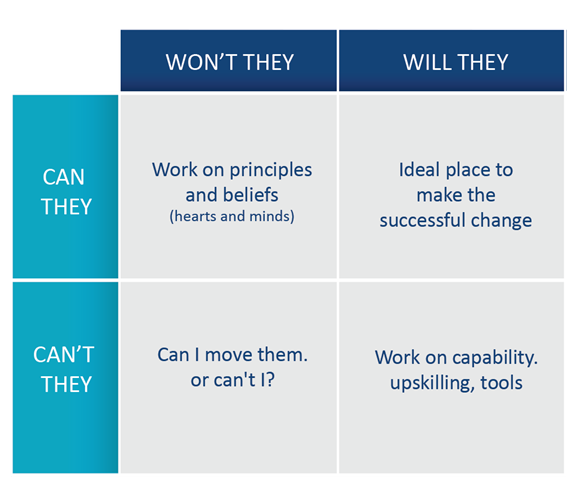
The goal is to understand who is willing to change, who is not, who is capable of adapting with the right support or upskilling, and who may be unlikely to adapt successfully without more significant intervention.
When leaders understand where people sit, compared with where they need them to be, it usually becomes easier to craft the right change strategies. Communication, engagement, sponsorship and capability-building can then be shaped around what's really required, rather than assuming the same approach will work for every group.
Willingness: Will they, won't they
During transformation, leaders are often encouraged to communicate a clear narrative around why change is occurring and what the transformation is intended to achieve. It's the quintessential challenge of capturing hearts and minds, as well as driving compliance.
That communication remains important, but employees are also assessing whether the transformation feels credible in practice. People pay close attention to whether leaders remain visible, engaged and consistent once delivery pressure increases.
For leaders, the "will they, won't they" question is therefore about more than whether people intellectually understand the rationale for change. It's also about assessing how willing individuals or teams are to genuinely support and participate in the transformation itself.
This can become one of the most difficult aspects of large-scale change. Some people may feel uncertain about the future direction or unconvinced by the benefits being communicated. Others may be reluctant to let go of established ways of working, particularly when transformation introduces ambiguity, operational disruption or perceived personal risk.
The quadrant approach gives leaders a practical way to assess where resistance or hesitation may be emerging across the organisation. Importantly, it can also help distinguish between employees who are uncertain but open to support, and those who remain deeply resistant to the transformation regardless of communication or engagement efforts.
The leadership response required in each situation may be very different. In some cases, stronger communication, sponsorship visibility or more direct engagement may help build confidence and alignment. In others, leaders may need to make difficult decisions to ensure persistent resistance doesn't significantly undermine transformation delivery or broader organisational momentum.
Capability: Can they, can't they
Willingness alone does not guarantee successful adoption. The second half of the quadrant requires leaders to assess whether employees have the capability, support and confidence to adapt successfully to the transformation. It's the "how" part of your change equation.
In many transformation environments, employees are being asked to adopt unfamiliar systems or ways of working, while still maintaining operational delivery expectations. Even highly engaged teams can struggle if they don't feel equipped to operate effectively in the future state.
Capability building therefore becomes a critical part of transformation readiness.
Importantly, capability is never fixed. Many employees can successfully adapt to new technologies and responsibilities when given the right support and training, and when the leadership environment helps to set them up for success. However, capability challenges can still emerge during large-scale transformation, particularly where changes are highly complex or where uncertainty has already affected confidence and engagement across teams.
The "can they, can't they" lens helps leaders assess where additional capability uplift or operational support may be required across the organisation. It can also help identify situations where individuals may be willing to support the transformation, but are struggling to adapt to the practical demands of the role itself..
Capability-building during transformation often extends beyond formal training programs. In many cases, it involves reshaping how work is performed, how teams operate and how employees engage with changing delivery expectations over time.
Used well, the framework helps leaders identify where support or capability development may strengthen transformation outcomes before performance gaps become more deeply embedded across the organisation.
Using a readiness framework across the organisation
People rarely respond to change in the same way. In the context of transformation programs, challenges emerge because leaders underestimate how differently teams experience uncertainty and changing delivery conditions.
The "will they, won't they, can they, can't they" framework is valuable because it gives leaders a practical way to assess those dynamics in real time. It helps identify where stronger sponsorship, clearer communication, capability uplift or more direct intervention may be needed before delivery risks become more deeply embedded across the organisation. It can also help leaders recognise where resistance, capability constraints or role misalignment may require difficult decisions rather than additional support alone.
Understanding where people sit, and why, allows leaders to respond more effectively as transformation conditions evolve, while accepting that not every individual will make the journey successfully.
Whether you're leading a project, PMO, or driving transformation, we invite you to stay informed and connected. Join the Quay Roundtable Network for access to expert insight, practical tools and real-world discussion that cuts through the noise.
Quay Consulting is a professional services business specialising in the project landscape, transforming strategy into fit-for-purpose delivery. Meet our team or reach out to have a discussion today.